
Before You Sign: Six Things Every Homeowner Should Understand About Their Builder's Contract

project preparation: the devil is in the details
There is a particular kind of excitement that comes with reaching contract stage on a new build or renovation. You’ve found your builder, your plans are approved and the project that has lived in your imagination for months, sometimes years, is finally about to become reality. The temptation to sign the builder’s contract and get underway immediately is completely understandable.
But the contract stage is also one of the most consequential moments in the entire process. What you agree to here, and what you understand about what you’re agreeing to, will shape your experience, and your investment, from the first day the builder is on site to the last, and, perhaps, even longer.
First, a note about your builder. Above all else, you need to feel genuinely confident in the team you’re building with. Your builder, and his sub-contractors, will be part of your home and your life for months, or even a year or more. That relationship, built on communication, trust and mutual respect, is worth more than any contract clause. These tips are not about approaching your builder with suspicion. They’re about arriving to the table as an informed client, which ultimately, is the way to get the most from your project.
With that said, here are six things I want every homeowner embarking on a renovation or build to understand before they sign.


“If you don’t know where you are going, you’ll end up someplace else.”
#1: Understand PC and Provisional sums
First, a definition of both. Prime Cost (PC) and Provisional Sum (PS) Items are among the most common source of budget blowouts in residential building projects, not because builders are being dishonest, but because homeowners often don’t understand what they are or what assumptions sit behind the figures in their contract.
A Prime Cost Item is an allowance for a specific product or material that hasn’t been selected at the time of contract finalisation. Think tapware, appliances, light fittings, door hardware, etc. The contract includes an estimated supply cost and, in some cases like tiles, quantity; once you make your selection and quantities are confirmed, the contract price adjusts accordingly. If you choose something more expensive than the allowance, you pay the difference plus the builder’s margin on that difference.
A Provisional Sum Item covers work (materials and labour) that isn’t, or can’t, be fully scoped at the contract stage. Excavation is a classic example. Until someone digs, no one knows exactly what’s lurking down there. But, builders also frequently use provisional sums for things like electrical work, tiling, and even joinery, particularly in renovations where designs are not finalised or detailed enough to quote.
The critical question to ask for both is: what assumptions were these figures based on?
Because, the difference between a hollow-core door and a solid core door may not be significant at first, but when you multiply that across the number of doors in your renovation, it adds up. Another example applies to tiling: does the contract allow tiles to the ceiling or just the shower recess. If your contract allows for a $30 per square meter matte white, rectified tiles and you have your heart set on $150 per square meter handmade zellige tiles, the price gap will grow, and with margin on top, can become significant. Each of these differences will make a big cost impact as the project progresses.
I recommend walking through each PC and PS item in the contract schedule. Ask your builder to step you through the assumptions for each one. Ask what level of finish or specification was assumed. And, do your research ahead of time. Know what you envisioned and approximately what it costs. If the builder’s answer doesn’t match your vision, address it before you sign, not after.

#2 - Understand builder’s margin
Most homeowners are aware that their builder charges either a margin or a markup on everything he/she purchases. Fewer understand what it actually means in practice, and the gap between the two can be suprisingly significant.
Here’s the distinction that matters:
Markup is a percentage added on top of the cost of an item. A 42% markup on a $1,000 item means you pay $1,420.
Margin is the profit gained, expressed as a percentage of the selling price. A 30% margin on the same $1,000 item also means you will pay $1,420.
While the end amount is the same, ie a 30% margin is equivalent to 42.8% markup, a 30% margin sounds considerably more modest than a 42% markup. And, if you see margin but are thinking of this as markup, the difference in cost is considerable. Note: these numbers are not hypothetical and it is not an uncommon contract inclusion but it is worth understanding what is included in your contract and what it means in real terms before you sign.
The margin question also extends beyond the headline rate. Ask your builder:
Is margin/markup applied to the trade/wholesale price or the retail price?
Is margin/markup applied to delivery fees?
When a PC item or provisional sum exceeds its allowance, is margin charged on the full cost or only on the excess above the allowance?
The last point is important. The correct approach for a fixed fee contract is that the builder’s margin on a PC or provisional sum overrun applies only to the amount above the original allowance, not to the full cost of the item. It is worth clarifying that your contract reflects this.
And, note, none of this means the margin is unreasonable. Building is a complex, skilled and risk-laden business and we want our builders to be profitable. Going in with a clear understanding means there are no unpleasant surprises mid-project.


#3: What isn’t included
Knowing what isn’t included in your contract is as important as knowing what is. Every building contract has a scope of work and every scope of work has an edge. The question is whether you know where that edge is before you sign.
For new builds, common exclusions include landscaping, driveways, and fencing as well as items often excluded from renovation contracts such as window treatments and floor coverings. Note, when a contract references floor coverings being exclude it does not refer to area rugs. It means you will receive a finished slab or substrate and will need to arrange, and fund, your own flooring supply and installation separately, whether you select timber floorboards, tile or carpeting.
With extensions and additions the exclusion question can be more nuanced. Ask specifically:
Does the contract include ‘make-good on existing areas’ where the extension or addition meets the original home? Matching the existing cornicing, skirting, paint finishes and flooring across the junction can be a meaningful cost, and cumbersome extra project, if not included.
What does the ‘handover condition’ actually look like? Will you receive a painted, finished, floor-covered, light-fitted and clean space? Or, something that still requires several trades and several weeks of additional work before you can fully move in?
Review the exclusion list with the same care you give the inclusions. They are equally important and, if not considered, quickly deflate the joy you feel at the end of an otherwise great project.

#4: Understand what design work is still to be completed
This is the one that surprises people most and it can have a big impact on both stress levels and budget.
The drawings prepared to obtain your Complying Development Application (CDC) or Development Application (DA) approval are planning documents. They demonstrate to council that your building meets the relevant codes and regulations. They are not, and aren’t intended to be, construction documents - a complete set of instructions for how to build and finish your home.
What your DA / CDC drawings almost certainly don’t include are critical things like:
An electrical plan showing the type and positioning of light fixtures, how they are switched and dimmed, where powerpoints are positioned and how many there are
Joinery design detailing the internal layout, dimensions, material specification and hardware for every space - kitchen, laundry, bedrooms, study, entertainement unit, vanity etc
Finish specifications including paint colours, flooring selections, wall tiles, grout colour, tap style, and so on. And, within each of these, the details. So, for tiles - which direction will they be laid, how big are the grout lines, will they be mitred at corners etc.
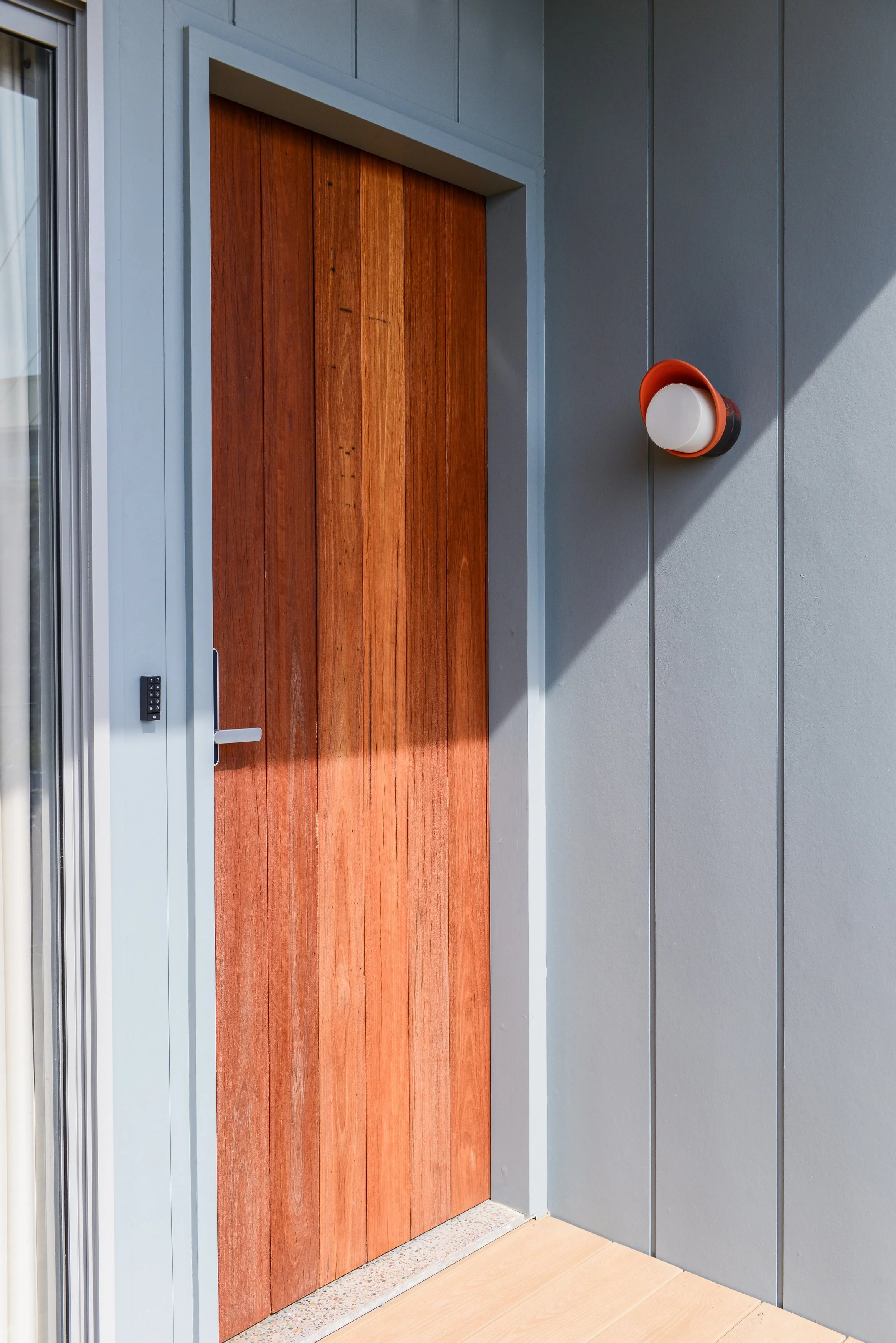
Hardware selections - which door handles in which finish, are they lockable using a built-in privacy pin or a separate snib, what type of hinges are being used etc
All of these decisions, and more, need to be made. The question is when, and by whom. If they aren’t resolved before you sign, they become either PC items (with allowances the may not match your vision), provisional sums (with estimates that may not match reality) or variations issued mid-build (with fees and margin applied). Add to this the pressure of making decisions in real time while the site is waiting…
This is where an interior designer earns their place in the process, not at styling stage, but here, before the contract is signed. Good design documentation takes time but it resolves exactly these decisions in advance, in a considered and coordinated way, so that what goes into your contract reflects what you want to build, what you are prepared to invest in and the outcome your dreaming of achieving.


#5: Understand how variations are managed
Even a well-resolved project will generate some variations. Site conditions, product discontinuations, and the occasional change of heart are all part of building. What matters is understanding the mechanism on how these are handled before they happen.
A variation is any change to the agreed scope of work, an addition, an omission or a substitution. Your contract should set out clearly how variations are initiated, priced and approved. In most contracts, variations must be agreed in writing prior to work, or orders, proceeding. If you are presented with a variation after the fact, you are in a more difficult position.
A few questions worth asking before signing on the dotted line:
Can variations be bundled. Man builders will group several small variations into a single variation request, which can be efficient and save you on management fees. But, ask what happens if you approve a bundle then decide that one element that has been quoted is outside of your budget and you want to remove it. Does the pricing of the remaining items hold? Does the removal initiate another variation request with anther administration fee? Get clarity upfront.
Is there a minimum variation fee? Some builders charge an administration fee per variation regardless of scope. if you anticipate making changes, understanding this cost is worth doing in advance.
How is margin applied to variations? The same margin rate that applies to other areas of your contract typically applies to variations, including, in some contracts, to any PC or provisional sum item that is processed as a variation.
The broader principle: variations are almost always more expensive than decisions made at design stage. Every change requested mid-build carries an overhead in cost, in time, in margin and often in disruption to the project schedule. The more resolved your design is before work begins, the fewer variations you'll face.


#6: Design as much as possible before you sign
If there is one piece of advice that underpins all of the above, it is this: resolve your design before you commit to your contract. Not the broad strokes, the detail. The lighting layout and selection. The joinery design + specification. The floor finishes. The tapware and positioning. The hardware. All of it.
I know this can push out a start date that you’re excited for and the builder is pushing for. The pull to get started and figure it out as you go is strong. But that instinct, however understandable, is the single most reliable way to budget overruns, decision fatigue, and a home that doesn’t quite match what you have been dreaming of.
Heres’s what resolving your design before contract actually delivers:
Fewer PC and provisional sum items. When your tapware is specified, it’s a fixed price in the contract, not an allowance for an unknown product. When your joinery is designed and documented, it can be properly tendered. Every decision made in advance is a variable removed.
Fewer variations. Variations are the most expensive way to make decisions. When the site is running, time is money and changes cost more, in margin, in disruption and, sometimes, in work that needs to be redone.
A clearer picture of the true cost. The more resolved the design, the more accurate the contract price. The gap between the contract price and final cost is, in large part, a measure of how much was left unresolved before starting.
Less overwhelm during the project. Renovation and build projects can be stressful even when fully detailed and well-managed. But, anyone who has been through a build without full documentation, will tell you about the relentless requests for decisions that arrive when you least can handle it: at 6pm on a Thursday, when you’re rushing to pick up the kids from after school sport and put dinner on the table, the builder phones asking you to choose your gutter colour, an architrave profile, your toilet suite, or the light switch finish by 7am tomorrow morning. When these decisions have been made in advance, considered, coordinated and documented, they simply don’t arrive as a crisis.
Freedom to choose what you actually want. That light fitting that you fell in love with an 18-week lead time? The tapware finish that isn’t available for another 12 weeks? If you don’t know you need it until the electrician or plumber is on site, it’s not going in your home. Design done in advance gives you the time to source, order, and have exactly what you want waiting when the site is ready for it.
This is the work that an interior designer does before a contract is signed: resolving the detail, documenting the decisions, and making sure what goes into your contract reflects the home that you are actually building. In my experience, it is one of the most valuable investments you can make in your project, and one most often left until it’s too late.
about to embark on your project?
Building and renovating are one of the most significant investments you will ever make, financially, emotionally and in terms of the time and energy it asks of you. Going in with a clear understanding of your contract, with as many decisions resolved as possible, doesn’t diminish the excitement. It protects it.
If you’re planning a new build or renovation and would like to talk through how good design documentation can set you and your project up for success, I’d love to hear from you. Schedule a Call Now
